Protected by Copyscape Duplicate Content Check

Subscribe by Email and get notified about new postings as soon as they happen!

Your email:

Check Out This DVD About RRP Work Practices

This DVD, produced by Chris Zorzy, contains great time saving solutions for complying with the RRP Rule.   Chris shares a variety of containment strategies that will help keep your jobsites clean, reduce job costs and meet RRP requirements

Looking For RRP Forms and Signage?

Shawn has reviewed these forms, helped the provider enhance the forms and recommends them as a great option for those who want to use paper forms to document compliance with the EPA RRP rule.

Lead Paint Fors Store Banner

LeadPaint FormsStore.com

Browse Topics by Tag

I just wanted to say thank you for your efforts to keep us informed.

"Thank you again for the hundreth time for keeping a vigil on this business nightmare. Your site is one of the best resources we have to stay on level ground" 

Christian Peter


"I am quite impressed with all the confusion out there at Shawn McCadden’s clear and concise voice that continues to help contractors and those involved in this industry truly understand the rule. His efforts should be applauded." 

Christopher Wagner, LBPFiles


"RRPedia is an accurate and contractor friendly interpretation of the very complex and confusing EPA RRP rule"


"Thanks for taking the time to write the blog.  It's about the only place one can go to get some serious info on this dreadful subject"

Suggest or Contribute a RRPedia Topic

Want a Simple Summary of the EPA RRP?

Shawn McCadden has created an EPA RRP Summary for Remodelers.

"Hi Shawn, Nice RRP write up on the website.   I've already forwarded a link to it to a number of local builder types."  

Click here to go to the summary.  You can also download it if you want your own copy.

Add this widget to your Web page, blog, or social networking site. A widget is a CDC.gov application that displays the featured content directly on your web page. Click the buttons to see the next tip to prevent lead poisoning.


Welcome to RRPedia
Your Interactive Resource for EPA RRP Information

Looking for accurate information about the EPA RRP rule?

RRPedia RRPedia logohas been created by Shawn McCadden to help remodelers and others affected by the New EPA Renovation Repair and Painting Rule. 

Please read RRPedia Use and Contribution Information before using or contributing to RRPedia

Be sure to Read Shawn's Remodeling Magazine Blogs about the EPA RRP Rule.  Click here to see a list

Keep checking back.  Information about a wide range of RRP-related topics will continue to be added. 


You Can Browse For RRP Topics By Using The Tags List To The Right

Current Articles | RSS Feed RSS Feed

What You Don’t Know About Respirators and Probably Would Rather Not Know


Please read RRPedia Use and Contribution Information before using or contributing to RRPedia

What You Don’t Know About Respirators and Probably Would Rather Not Know

On December 2nd I attended an RRP/OSHA Respiratory and Worker Protection Workshop put on by The Contractor Coaching Partnership and Safety Trainers.   The workshop was really helpful for me.  It helped me tie together some of my open questions and concerns regarding OSHA requirements and compliance as they relate to RRP related work activities for employees.

Respirators for RRP workWhile at the workshop I found one thing the main instructor Darcy Cook of Safety Trainers said to be very important for contractors to be aware of.   Under the OSHA Lead in Construction Standard, contractors must assume their employees will be exposed to lead above OSHA’s established action level requiring the use of respirators until they actually conduct air monitoring testing to prove otherwise.

This means that respirators must be worn while doing RRP work until the testing is done and a written respirator plan is put in place that details when a respirator is required and when it is not.   Engineering controls can be used to limit the creation and or spread of lead dust while work is performed.  The requirement to wear the respirator or not all depends on the kind of work being done as well as how the work is performed. 

For example; the sanding of painted surfaces.  If dry hand sanding is done, a respirator will definitely be required.   If wet sanding is done a respirator may not be required.  If the sanding is being done using a sander attached to a functioning HEPA Vac that captures all sanding dust, a respirator is probably not required.   The previous sentence is qualified with “may” and “probably not” on purpose.  The only way to know if a respirator is required or not is to monitor the air for lead dust while the work is actually being performed.

The chart below is from the EPA Certified Renovator Manual.  The chart shows exposure levels of airborne leaded dust for some common renovation activities.   OSHA’s permissible exposure limit (PEL) for workers is 50 Micrograms per centimeter squared (50 µg/m3).   If exposed over the PEL, workers must wear respirators.  All three activities in the chart exceed the PEL.
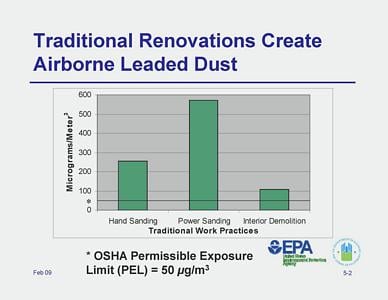
 

Airborne leaded dust, OSHA PEL   

Respirator fit testing and OSHA Respirator Fit Testing RequirementsSo, under OSHA requirements, before allowing them to do RRP related work or even enter a contained work area, employees must first be sent to a physician to be sure they are healthy enough to wear a respirator. Then they must be fit tested by a professional and provided with a properly fitted respirator that protects them from worst case lead exposure scenarios based on the kind of work they do. They must also be trained how to select, use, clean and store a respirator.   And, they must wear the respirator until the air monitoring testing is done to identify when a respirator is required and when it is not depending on how the work is performed and what engineering controls are being used.

Although these OSHA requirements are not new, the majority of residential contractors are not aware of them.  Unfortunately, ignorance of the requirements will not be an excuse if OSHA inspects one of your projects and or one of your employees is poisoned by lead.   Perhaps it would have been helpful if EPA had included the above information in the required eight hour certified renovator training when showing the chart above.


Click here for more information about Personal Protection Equipment (PPE) required for RRP work

Click here for more about what you need to know about Respirators when doing EPA RRP work

Click here for OSHA standards for cleaning a respirator

Comments

Shawn 
I have been an avid reader of yours for some time, and have either had my existing work practices reinforced or amended as a consequence.However, this article confounds me. 
Are we now to follow OSHA during RRP, or are we to selectively decide which regulatory agencies requirements (EPA, HUD, OSHA) are to be adhered to? And how would we know unless we have attended all of the available certification training available? I believe that even the most hard working, committed and safety conscious among us are becoming more rather than less confused, about being able to understand, and perhaps more importantly follow, all of the potential, unclear, overlapping and expensive requirements we seem to be exposed to. 
Perhaps EPA, OSHA and HUD could sit down at a table and produce a collective - single - document to explain what those of us who want to protect our homeowner clients and their children should do. 
My sincere thanks for working so diligently to help us try and understand how to navigate this maze.
Posted @ Thursday, December 16, 2010 7:06 AM by Graham Tamplin
Graham, thanks for your comments. You did a great job summarizing the challenges renovators are having trying to figure this whole thing out. It certainly appears that the regulating agencies (EPA, HUD, OSHA)did not work together when the RRP rule was assembled. Here ism one option I suggest you could consider to help get your thoughts to those who might be able to help us. Check out this link and consider sending me something that explains your concerns and how they are affecting your business. 
 
Be Heard: How Has The RRP Rule Affected Your Business?
Posted @ Friday, December 17, 2010 9:35 AM by Shawn McCadden
The OSHA lead in construction standard has been around for over 15 years. There have been no major changes to that rule.  


Unfortunately none of the contractors out there seem to have heard of it. Regardless of the amount of publicity OSHA tried to create, and trust me we try to educate and inform constantly, the folks who are being regulated don't seem to check into the requirements before they start working.  


“Gee, do you think that 100 year old house has any bad stuff in it?”...”Nah, lets just go break some stuff...” 


I mean seriously, you can’t just claim ignorance. Being a contractor is your job! You need to know about the stuff you are doing. I could give a hundred examples of where people don’t know the specific rules, but they usually look into the rules, before just going to work. (For example: people don’t just dig- they check where the gas or sewer pipe is, before they dig. Also, people don’t just dump stuff down the drain, or into the stream anymore. They check where they can dispose the waste properly. And people, don’t just throw asbestos around, and ignore it. They usually call someone that knows what they are doing.)  


I have given dozens of speeches to contractor groups. But, until recently, no one seemed to take advantage of the free training, air monitoring, etc. that OSHA has always offered (I know, I'm a compliance officer for OSHA, since 1997). I even had an owner of a large painting firm ask me if I had brought proof with me that lead was really bad for you. “Wow”, was all I could say.  


Seriously, you can't complain about these regulations. But no one starts a business and doesn't pay taxes, right? Unless they are blatantly going to break the law. But they know there are laws out there. They just choose to ignore them, and hope no one notices. Which no one does most of the time. Ignoring the EPA, OSHA, city, county, state, etc. regulations has been a way of life for the construction industry.  


So I don't feel bad for contractors in general. I do feel bad each time I slap some poor guy with a big fine because he didn't know. So, I try to give him a fair shake (keep the fine low, if he is a smaller contractor).  


There has been one really good thing about RRP. That is the fact that I no longer have to teach every single contractor I meet that..."Yes, lead IS bad for you! Oh, and by the way, there is lead in paint!” At least now they know that simple fact. Thanks RRP.  


But, if you still want to complain about all these rules, join the tea baggers. We can create another scandal like we just saw in the mortgage housing market. Let’s get rid of the evil government! They are out to....oh yeah, they are out to help us, and protect us, because we are generally to dumb to do it on our own. But, don't worry the free market will fix it. Those poor contractors have a hard enough time working, they shouldn't have to follow any more rules. Boo hoo.  


Get it together guys. It’s not hard. Just look into the rules, and follow them. If you screw up, take responsibility, and move on. Don’t blame the game- blame the player.  


PS- my dad is a contractor. I have a contractors license, and I know how "hard" (not hard at all) it is to follow the rules.  


Posted @ Wednesday, April 06, 2011 11:54 AM by Lead man
Lead Man 
 
Thanks for the comments you have been making on RRPedia. I think you offer some great and realistic perspectives.  
 
I would welcome you to do a guest blog on RRPedia if interested. Perhaps you could share some stories about the crazy things you see happening (or not happening) and what you are up against as an OSHA inspector. Or, suggest a topic of value. I think it would be interesting to keep your true identity anonymous, just perhaps sign it as “Unidentified OSHA Employee Trying to Help” or something like that. You can check out the guest blog tag on RRPedia to see what others have done and how the page would appear. If interested, I would be happy to answer any questions. I promised to keep your identity protected if that is what you desire. 
 
Let me know. Either way, I hope you will continue commenting 
Posted @ Friday, April 08, 2011 8:00 AM by Shawn McCadden
Post Comment
Name
 *
Email
 *
Website (optional)
Comment
 *

Allowed tags: <a> link, <b> bold, <i> italics