Posted by Shawn McCadden on Sun, Feb 05, 2012 @ 05:00 AM
Please read RRPedia Use and Contribution Information before using or contributing to RRPedia
What to do if EPA Sends You a Request for Information
Recently I found an article written by Anne E. Viner, a principle attorney at the Chicago law firm of Much Shelist, P.C. In her article Anne offers several practical tips for responding to governmental requests for information. I thought her article was well written, straight forward and easy for a contractor to understand. I got her permission to share some highlights here on RRPedia.
Anne points out that EPA Administrator Lisa was quoted to say “EPA is back on the job" and that EPA has received the largest enforcement budget in its history, making it more likely that your business will be subject to some type of investigation.
Below are some practical tips from Anne to keep in mind when your business receives a request for information from any government agency, not just from EPA regarding the RRP Rule. (I have summarized quite a bit, click here to see her full article.) This information should not be construed as legal advice or a legal opinion on any specific facts or circumstances.
-
Don’t respond to verbal requests: It is important to get all requests in writing, so that all parties clearly understand the scope of the information sought and the time period covered by the request. Without a written request, you risk being accused of failing to fully comply with a verbal request that you may have simply misunderstood. Asking the government to put its inquiry in writing is within your rights.
-
Determine if the government has authority to seek the information requested:
Although a written request for information should specify the statutory authority for the request, don't assume that the agency actually has the cited authority. Knowing the source of the government's authority for the request, as well as determining the applicability of the request to your business, is imperative in both limiting the scope of your response and protecting your business interests with customers and other parties that may be affected by the request.
-
Voluntary compliance versus litigation: Your business should be aware of the pros and cons of voluntary compliance versus requiring the government to follow more formal procedures such as issuing a subpoena or filing a lawsuit. Generally, cooperation is the better course at the early stages of an investigation. On the flip side, refusing to voluntarily comply with a governmental request may subject you to higher scrutiny and or administrative penalties. Of course, cooperation is not always an option, so understanding the risks of fighting with the government is essential at the outset.
-
Assume your company is a target and involve counsel early in the process: Regardless of the apparent target of the government's inquiry, assume that your business is, in fact, under investigation and may be subject to fines, penalties or otherwise embroiled in a civil or criminal enforcement action. An experienced environmental attorney can help advise your business concerning its rights and responsibilities.
-
Be honest: As we all learned in childhood, honesty is the best policy. Handling the request in an inappropriate manner could result in claims of obstruction of justice, interfering with investigations, or other types of administrative and civil violations.
Posted by Shawn McCadden on Thu, Feb 02, 2012 @ 03:40 PM
Please read RRPedia Use and Contribution Information before using or contributing to RRPedia
Latest Survey on the Impact of the RRP Rule on Businesses
On February 1st, 2012, Professional Remodeler Magazine released some information they collected from a December 2011 survey they did asking remodelers about how the EPA’s Renovation, Repair and Painting Rule (RRP) has impacted their businesses. No surprise, the survey indicated negative impact. 64 percent reported they had lost business as a result of the rule. What seems to consistently rise to the top is the impact of illegal competition from businesses that ignore the rule and its required work practices.

According to the excelent survey summary posted by the magazine’s Editor in Chief, Jonathan Sweet, 46 percent of respondents said less than 10 percent of remodelers in their local market are following the regulations and only 8 percent think more than half of their local competitors are in compliance.
The survey also asked about costs related to RRP. The EPA says additional costs are $35 to $376, depending on the size and the nature of the project. According to the survey results, 37 percent said the rule added more than $1000 to the cost of their average project and a full 81 percent said it adds more than $400. So much for the accuracy of EPA’s estimates.
Again, the survey proved what many have already determined in the past regarding consumer awareness about the rule: very few know anything about it. According to survey respondents, 65 percent of remodelers estimated that less than 10 percent of their potential clients are aware of the rule and only 5 percent think more than half of homeowners know about it. This is despite what EPA refers to as extensive consumer outreach.
One interesting observation I made about the survey results is that contractors in the northeast tend to be much more aware of the rule and much more in compliance with the rule than the rest of the country. For example, according to the survey results, 83 percent of remodelers in the Northeast were the most likely to be certified, compared to 75 percent in the West, 71 percent in the Midwest and 66 percent in the South. Also, 80 percent of remodelers in the Northeast described themselves as very familiar with the rule, compared to 70 percent in the Midwest and 61 percent in both the South and West. 
In summary, although the survey didn’t seem to provide any new information, its finding are still valuable. It did demonstrate that EPA has made very little progress getting the regulated community into compliance and with educating consumers about the rule and the reasons for it.
Posted by Shawn McCadden on Tue, Aug 16, 2011 @ 05:00 AM
Please read RRPedia Use and Contribution Information before using or contributing to RRPedia
Don’t Be Mislead By the Vote to Cut Off RRP Enforcement Funding
On July 13, 2011 the House Appropriations Committee voted to cut off funding for enforcement of the RRP Rule until a reliable test kit is recognized by EPA. The amendment was included in the House Appropriations Bill by Representative Denny Rehberg (R-Mont.).
Note: For clarification, a “reliable test kit” means a test kit that would be able to determine if a painted or coated surface contains lead equal to or in excess of 1.0 milligrams per square centimeter (mg/cm2) or 0.5% by weight. The current test kits will reliably indicate whether the surface contains any lead or not, but do not measure the amount of lead.
Unfortunately, as a result of the vote many renovators are now assuming that they no longer need to comply with the RRP rule and do not have to use lead-safe work practices on pre-1978 target housing and child occupied facilities. If you are a renovator making that assumption it would be a big mistake that could cost you big time. Let me explain.
First, any cut or stoppage of enforcement would only apply to states where EPA administers and enforces the rule. It would not have any effect at all in those states that have assumed administration and enforcement of the rule from EPA.
Regarding the vote, it is an amendment added to a proposed bill which must go before the full House and Senate for approval. Even if approved in the House and Senate it must then be sent to the president for his signature before passing. The president signing it, at least in my opinion, is not very likely. Obama had a lot to do with why the rule exists to begin with.
Even if the amendment to the rule were to go into effect, all it would do is take away the money EPA has to fund enforcement. It would not eliminate the rule. If and when a reliable test kit were to be eventually recognized by EPA, and finally made it to the marketplace, enforcement funding would then become available again.
EPA can eventually get you anyway:
Keep in mind that the rule requires that renovators keep all required documentation and that it be available for EPA audit for 3 years. That means EPA can retroactively enforce the rule 3 years back. If and when enforcement happens, all EPA needs to do is ask to see a renovators documentation to determine whether all the regulated work performed during that 3 year period was properly documented, met the rule’s requirements and that property owners and/or tenants received the required Renovate Right pamphlet, any lead testing results documentation as well as a copy of the required renovation checklist. Remember, the fine is up to $37,500 per violation per day!
Property Owners, Tenants and Parents can get you anytime:
Also, keep in mind that even if EPA can’t or doesn’t enforce the rule, your customers, their neighbors and the parents of children attending a child occupied facility can still sue you for not following the law. And, as a business, if accused, you are considered guilty until you prove you and your business is innocent at your own expense, money you cannot recoup in court.
Plus, one fact that many business owners may not be aware of is that, under the rule, the business owner can be held civilly liable for violating the rule. Don’t assume you are personally protected just because of the legal status of your business.
Posted by Shawn McCadden on Thu, Jul 14, 2011 @ 05:00 AM
Please read RRPedia Use and Contribution Information before using or contributing to RRPedia
Labels, Signs and Printers for RRP – and Beyond

Guest Blogger: Steve Stephenson is the Managing Director for Graphic Products at DuraLabel
You’ve been reading about the Environmental Protection Agency (EPA) rule which requires contractors performing renovation, repair and painting (RRP) projects that disturb lead-based paint in dwellings where children under six and/or pregnant women live to be certified and follow particular work practices including using signs and labels to prevent lead contamination.
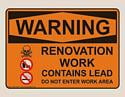
EPA 40 CFR 745.85 states that firms must post signs clearly defining the work area and warning occupants and other persons not involved in renovation activities to remain outside of the work area. These signs must be in the primary language of the occupants. The signs must be posted before beginning the renovation and must remain in place and readable until the renovation and the post-renovation cleaning verification is completed.
The EPA says that signs and labels must adhere to this hierarchy:
- The word “Warning” must be placed at the top of the sign
- Underneath “Warning,” the sign must say “Lead Work Area”
- Under that, “Poison”
- Finally, under “Poison,” the sign must say “No drinking, eating or smoking”
These types of warning signs and labels typically may be purchased pre-printed in bulk. Other types of signs are also often required. These are custom signs and labels for commercial jobs, final inspections and re-labeling painted pipes and drains. There are a number of approaches to making these signs and labels, too.
Consider:
- How frequently you’ll need to create new signs and labels
- How critical is visibility? Weather-resistance?
- Sign and label placement – indoors or outdoors?
- The ability to bring your printer to the jobsite for on the fly labels
The new DuraLabel Toro printer, for example, is battery-powered for mobility, comes with software for pipe marking and custom label design and prints one half inch to four inch wide labels at any length. Light adhesive tape supplies are repositionable and adhere to a variety of surfaces and textures – important when you need to place a label on a wall or in a kitchen that you’re in the midst of preparing to paint.
“I think that being able to re-apply the signs is a huge advantage as walls and finish surfaces tend to change during construction,” said Geoffrey Shafer, PEGASUS Design-To-Build.
As many contractors fit the DIY profile, we’re pretty sure that they’ll opt for creating their own signs and labels when they need them.
For more information about the DuraLabel family of mobile printers and rugged supplies for contractors, contact Steve Stephenson, Managing Director, Graphic Products and visit www.DuraLabel.com.
Posted by Shawn McCadden on Tue, Jun 28, 2011 @ 05:00 AM
Please read RRPedia Use and Contribution Information before using or contributing to RRPedia
The following information is from the NARI Government Affairs Committee’s newsletter of June 23, 2011 titled “NARI on the Hill”.
NARI Research on LRRP and Clearance Rule
NARI surveyed remodeling businesses and homeowners nationwide in order to gain a better comprehension about:
-
The impact of EPA's current Lead Renovation, Repair and Painting (LRRP) Rule, implemented in April 2010, on business.
-
Gaining a better understanding of how a proposed new layer of the EPA LRRP Rule, adding "lead clearance testing" would further affect business.
-
Gauging homeowner awareness of, and attitude toward the regulations.
Of the 1,500+ remodeling contractor respondents, only 25% reported doing any lead clearance testing at all. Regardless of cost variations, the majority of respondents reported that significant cost is added to a home improvement project with the addition of lead clearance testing.
In addition, respondents reported that the majority of their homeowner clients were not familiar with the EPA's original LRRP Rule, implemented in April 2010.
77% of respondents indicated that homeowners have sought ways to skirt the rule, by doing parts of the work themselves, or by hiring a non-certified individual to do the work. More than half of homeowner respondents in a separate survey indicated they would like the option to opt out if small children or pregnant women are not living in their home.
Why we did the surveys: We believe what all of you are saying out there, and we've been hearing your comments in blogs, social media, by talking to you directly. However, when trying to bring an issue to light in Washington, officials want current data to review, and providing anecdotal data as heard from third parties is typically seen as not credible, hence the surveys. NARI is sharing results of the research on Capitol Hill that EPA's implementation of the Renovation, Repair, and Painting rules may increase the likelihood of lead poisoning to children, as opposed to lowering the risk. Adding to this risk is the expected forthcoming of the Lead Clearance Rule, which will only exacerbate the problem. Additionally, NARI is reaching out to small business interest groups in Washington and media nationwide to make them aware of the survey results and how the rule is impacting your business.
***For more on NARI’s findings, read this blog article in the Wall Street Journal by Sarah E. Needleman. The Comments are even more telling as contractors affected by the rule share their opinions.
Posted by Shawn McCadden on Sun, Jun 26, 2011 @ 05:00 AM
Please read RRPedia Use and Contribution Information before using or contributing to RRPedia
The following information is from the NARI Government Affairs Committee’s newsletter of June 23, 2011 titled “NARI on the Hill”.
NARI Work Group Findings on LRRP
From March through June 2011, a dedicated work group of NARI members regularly convened for the purpose of documenting challenges in the application of EPA's Lead Renovation, Repair and Painting Rule (LRRP Rule). NARI's purpose is to convey to the EPA what is working and what is not working in implementation and to make recommendations. The work group identified the following prioritized concerns with recommendations:
Concern #1
The rule application is presented as a "one size fits all" and fails to provide guidance on the varying conditions often found on job sites.
Recommendation #1
The EPA should revise the rule to define the desired outcomes and provide a tool box of options to address varying conditions.
Concern #2
The cost of compliance is driving homeowners to either DIY or hire an uncertified renovator thus defeating the purpose and intent of the rule. Also, the rule does not address the contractor's responsibility when the work of disturbing lead paint has been undertaken and completed by the homeowner or an uncertified contractor.
Recommendation #2
The EPA needs to educate the general public about the rule, clarify the contractor's responsibility under this scenario, and assess the impact of homeowner-initiated projects on childhood lead poisoning.
Concern #3
The EPA lacks an effective method of providing updates and information on the rule. The website housing over 600 FAQs is not a feasible communications tool.
Recommendation #3
EPA and states with oversight should provide a regular newsletter with necessary updates. The website should be overhauled addressing the topical information needs of the user.
Concern #4
The rule is not clear on the training and certification requirements for subcontractors used by the certified renovator.
Recommendation #4
The EPA should clarify the responsibilities of subcontractors and define a "certified renovator of record" as a single point of contact throughout the project.
Concern #5
The model training program is not consistent with the current rule. Curriculum and materials do not reflect amendments.
Recommendation #5
The EPA must exercise responsibility in properly maintaining training curriculum and material content.
Why we convened a Work Group: to inform various entities in Washington about the issues with regard to this regulation. Since regulatory reform is a hot topic in Washington right now, the time is right to share these findings and garner more support. When trying to bring an issue to light in Washington, officials want current data to review, so the Work Group convened for a current, detailed analysis and NARI is sharing recommendations of the Work Group in Washington.
A copy of the complete report is available by request by e-mailing: gac@nari.org.
Posted by Shawn McCadden on Fri, Jun 24, 2011 @ 04:17 PM
Please read RRPedia Use and Contribution Information before using or contributing to RRPedia
Contractors Sound Off About RRP Rule and Dust Wipe Amendment
Thanks to PR activities by NARI, Wall Street Journal Blogger Sarah E. Needleman wrote a blog regarding the increased costs to both contractors and homeowners related to the RRP rule and the potential additional increase in costs should the EPA go forward with its proposed Dust Wipe Clearance amendment. The article is just one of very few where the media has really taken the time to understand the impact of the RRP rule and provide accurate information for their readers. Kudos to Needleman!
The blog was posted on June 23, 2011 at 4:35PM. At the time of writing this, exactly 24 hours later to the minute, there were already over 80 comments left by contractors expressing their opinions and concerns about the rule as well as their disappointment in our government for allowing such a shortsighted regulation.
Many point out that one of the consequences of the rule is that now more children have been put at risk for lead poisoning; for two reasons. The first is due to the fact that illegally operating contractors are under-bidding compliant contractors because they are ignoring the required lead-safe work practices and therefore creating lead hazards. The second is that homeowners are either doing the work themselves and or doing the demolition stage of the work themselves to avoid the added costs related to the rule’s required lead-safe work practices.
As Ben Franklin once said: “We must all hang together, or assuredly we shall all hang separately.”
I encourage all contractors to check out the blog and leave a comment of their own. NARI will be using the comments in their efforts to provide evidence of the rule’s impact and negative consequences as they meet with government officials and politicians in their efforts to get the EPA to recognize its shortsighted approaches to the rule.
Also, I encourage you to check out this RRPedia post for a list of additional ways the rule will affect contractors, homeowners and our great country. Please consider forwarding a link to this RRPedia blog post to other contractors and homeowners and ask they read about the consequences of the rule; then use what they have learned to add comments at Needleman’s blog.
Here is the link, please copy it and send it to others who can help all of us hang together for our common good!
Follow this link to find out about the negative consequences of the EPA RRP Rule and leave your comments.
Posted by Shawn McCadden on Mon, May 30, 2011 @ 05:00 PM
Please read RRPedia Use and Contribution Information before using or contributing to RRPedia
If An EPA Recognized Lead Test Kit Indicates No Lead, Can A Non-Certified Firm Do The Work?

This can be tricky. Keep in mind that for RRP purposes, only a certified renovator or licensed lead testing professional can do testing to determine that no lead is present. As EPA indicates in their answer below, if the certified renovator working for a certified firm does the testing, that firm must maintain the required documentation regarding the testing. So, if the firm that did the testing is doing the renovation, and the testing shows no lead, they can hire (subcontract to) non-certified firms and non-certified workers to do the work.
Question: If a certified renovator using an EPA-recognized test kit determines that the components that will be affected by a renovation are free of lead-based paint, can a firm that does not have RRP certification do the actual renovation work? What record-keeping requirements would apply?
EPA Answer: Where a certified renovator uses an EPA-recognized test kit, follows the kit manufacturer’s instructions, tests each component affected by the renovation, and determines that the components are free of paint or other surface coatings that contain lead at regulated levels, the renovation can be performed by a non-certified firm and without regard to the work practice standards or record-keeping requirements of the RRP Rule. See 40 CFR 745.82(a)(2).
However, the certified renovator and firm making the lead-based paint free determination are still subject to the recordkeeping requirements of 745.86(b)(1)(ii) and 745.86(a). Specifically, the certified renovator must prepare a record that states the brand of test kit used, the components tested, and results of the tests. The certified renovator’s firm must retain a copy of this record for three years. EPA further recommends that the firm actually performing the renovation also retain a copy of these records to demonstrate that compliance with the RRP Rule was not required.
So it appears that a non-certified firm can do the work if testing that proved no lead was found was done by someone else, as long as the determination was made by a certified lead inspector or risk assessor, or by a certified renovator using an EPA recognized test kit and following the kit manufacturer’s instructions. The key is however, that the non-certified firm must have written proof from the person or business that did the testing that there is no lead in the work areas to be disturbed.
So, here is the rub.
If you are a certified firm and have a certified renovator do the testing, and you give the homeowner a copy of the testing report you create, that homeowner could then hire a non-certified firm to do the work because that homeowner and the non-certified firm they hire can use your test results to avoid RRP firm and work requirements. Think about this before you test and make your own best decision about if and when you will test during the sales process.
Posted by Shawn McCadden on Fri, May 27, 2011 @ 05:00 AM
Please read RRPedia Use and Contribution Information before using or contributing to RRPedia
Do My Sub Contractors Need To Be RRP Certified?
There has been a lot of confusion regarding the details of the EPA RRP rule. One that seems to pop up over and over is certification requirements for sub contractors. There are two different certification considerations regarding sub contractors; firm certification and worker certification. Let’s take a look at each separately.
Firm Certification for Sub Contractors:
The EPA is very clear on this. The following question and answer comes from the EPA web site’s FAQ page:
Question: My firm performs renovations covered by the RRP rule, but solely in the capacity of a subcontractor. If the general contractor is a certified firm, does my firm also have to be certified, or can we just provide the certified renovator?
EPA Answer: All firms performing, offering, or claiming to perform renovations covered by the RRP rule must be certified. In this case, both the general contractor and subcontractor must become certified firms.
Whether working for the general contractor as a trade partner or a 1099 sales person (offers the work), sub contractors must become certified firms by apply for certification through the EPA. Ensuring that the subs they use are certified firms is particularly important for general contractors, because as part of the required documentation under the rule, the renovation checklist must include the names of all workers who participated in RRP activities on the job. If a sub contractor and his workers do work on the job and the sub’s firm is not certified, the EPA will easily be able to find both the general contractor and the sub in violation of the rule. If a general contractor knows that subs must be certified firms, hiring a non-certified firm to work on a job becomes a knowing and willful violation of the rule, which brings with it serious penalties. It’s also one easy way for a customer’s lawyer to suggest the contractor is/was negligent.
Note: Both Massachusetts and Rhode Island have this same requirement for sub contractors.
Worker Certification for Sub Contractors:
Again, the EPA is very clear on this. The following question and answer comes from the EPA web site’s FAQ page:
Question: Under the RRP Rule, can a certified renovator supervise workers of a different company, or must each firm involved in a project furnish a certified renovator?
EPA Answer: All firms performing renovations must ensure that all individuals performing renovation activities on behalf of the firm are either certified renovators or have been trained by a certified renovator. The RRP Rule does not prohibit firms from reaching agreement on which will supply the certified renovator who is responsible for ensuring compliance with the RRP Rule and who directs and trains non-certified workers. All firms remain liable for ensuring compliance with the RRP Rule.
Who is Liable, The General Contractor or the Sub?
The following question and answer provides clarification regarding the responsibility and liability of the business that is acting as the general contractor:
Question: Is the certified renovator assigned to a specific project responsible for the work practices of other contractors on the project if the certified renovator is an employee of the general contractor of the project?
EPA Answer: All firms performing renovations must ensure that all individuals performing renovation activities on behalf of the firm are either certified renovators or have been trained by a certified renovator. A firm acting as a general contractor may satisfy this requirement by hiring another certified firm that takes responsibility for ensuring that all individuals performing the renovation activities are either certified renovators or have been trained by a certified renovator. With respect to assigning a certified renovator who is responsible for any on-the-job training and regularly directing workers who are not certified renovators, a firm acting as a general contractor my satisfy this requirement by hiring another certified firm that in turn assigns a certified renovator to the job. However, this does not discharge the general contractor's liability to ensure compliance with the Renovation, Repair, and Painting Rule.
Note: The answer above also applies in Massachusetts, but does not apply in Rhode Island. In Rhode Island, the RI Lead Hazard Control Standard (Section 14.0) requires the Licensed Lead Hazard Control Firm (LHCF) to have a RI licensed Lead-Safe Remodeler/Renovator (LRM) designee as a condition of licensure.
Posted by Shawn McCadden on Wed, May 25, 2011 @ 05:00 AM
Please read RRPedia Use and Contribution Information before using or contributing to RRPedia
Undercover News Investigation Calls Out EPA on Lack of RRP Enforcement
The video below from newsnet5.com offers a good summary of the challenges renovators are up against due to illegal competition and a government that has mandated a law that is meant to protect children without the resources and commitment to follow through. Without enforcement, in addition to causing challenges for complying businesses, the law offers a false sense of security for children and their parents who believe the government is protecting them from lead poisoning. In fact, as the video points out, the law is in effect actually causing more lead poisoning because of the lower priced illegal contractors who ignore lead-safe work practices.
The RRP rule has definitely contributed to expanding the underground economy in the remodeling industry. Illegally operating businesses and moonlighters ignoring the rule as well as the required work practices have been stealing work away from legally operating businesses, mostly due to the fact that they can offer much lower prices than those who comply. This has made it very challenging for many renovators. It has also put many children at risk of lead poisoning.
At a RRP workshop I attended last week, sponsored by the Lead and Environmental Hazards Association (LEHA), several renovators complained to Mike Wilson of EPA about EPA’s handling so far of the RRP rule. One after the other renovators cited examples of projects they had lost to other businesses that are ignoring the rule. Several even reported home owners had laughed at them when they tried discussing the rule and its requirements. One attendee reported that a homeowner actually told him that he would find another contractor who would ignore the rule as a way of saving money. It all seemed to be new news to Mike Wilson who told us he oversees RRP Policy, so could not comment specifically about enforcement. When asked what message he would bring back to the EPA in Washington after the meeting, Mike said he would let them know that regulated contractors wanted a level playing field. Attendees let Mike know that they have been already giving that same message to EPA, perhaps if Mike delivers the message the leadership at EPA will listen and take action.